Thursday, September 4, 2014

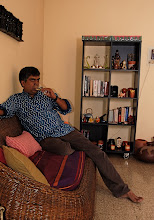
'One Kind of Happiness' VIJAY NAIR 1962-2013


“If those whom we begin to love could know us as we were before meeting them … they could perceive what they have made of us.” Albert Camus

In his 50 years, Vijay refused to be cubbyholed. He was a writer, a playwright, a poet, a good actor (mostly off stage), a bad singer, and an even worse dancer. He kept his role of a corporate trainer but spiked it with generous dose of theatre and creativity.

How can then one even begin to comprehend the irony when his life now is so definitely contained in between the years he came and went from this world?

It is too early, too soon.

Through these images I would like to share my memories of him which flit about knowing no boundaries.
  
“Memory is like that. With different people it assumes different shapes,” he wrote in his unpublished book, ‘One Kind of Happiness’.


I choose to shape mine in a full moon, drawing solace from the reflected sunshine.


This floor-to-ceiling bookshelf was especially made for Vijay in his study in our new house. He organized the shelf himself (a rare event considering being organized was not his habit) though in no particular order much to my consternation. He never worked in the study though, choosing the dining table instead to do all his writing.


Vijay’s idea of a holiday was a comfortable hotel room with the television on at all times, except when the new Harry Potter series was out. Here two people read, no, consumed ‘…the Deathly Hallows’ in one go. That’s how Vijay inculcated the love for reading in Dhruv since he was two. Reading stories out loud was almost a ritual before bedtime.


Vijay loved to eat and cook for others. In 2012 when he went to Pittsburgh on a Fulbright Fellowship, he had practically opened an Indian eatery in his residence. The friends he made there would often cook up some excuse or the other to drop by. He loved making chana masala, jeera rice, chicken curry, and mushroom stir fry for them. Once he even fried puris setting off the fire alarm!


If he had had his way, every weekend would have been a party in the house. In Pittsburgh, he did just that. The fridge was always stocked and the door always open! Writers and poets, lawyers and librarians to mill workers and managers, he entertained an eclectic crowd. He had a knack to draw out stories of other people. ‘How else will I write my books,’ was his justification.   


Tuesday, April 23, 2013

In Defense Of Rahul Gandhi...


My subjective evaluation of him hinges to a large extent on the first memory of seeing him on television. It was during his grandmother’s funeral and Rahul Gandhi was 14 years old at that time. He was standing next to his younger sister in front of the funeral pyre. I don’t think the enormity of what had happened had sunk in for both of them.

Their cousin Varun was a toddler at that time. Maneka Gandhi had made a dramatic exit from the Gandhi household along with her infant son after her husband’s death and ensured the press had arrived at an opportune moment to capture the family feud on camera. Maybe Rahul and Priyanka had slept through the entire sorry episode.

As soon as Varun arrived with his mother, a smiling Priyanka forgot the seriousness of the situation and ran to hug her cousin while Rahul looked on indulgently. Neither of his parents had made a foray into politics at that time. And it was evident to the entire nation that both the children had been brought up well. The poison of broken relationships had not afflicted them.

I would notice him again, seven years later. At the funeral of his father, looking distraught. Trying to come to terms with yet another blow life had dealt him.

It can be argued that both his grandmother and father had fallen victim to their own political machinations. It’s no secret that Indira Gandhi had created the Frankenstein of Bhindranwale and the entire tragedy leading to the storming of the Golden Temple and her subsequent gunning down by her bodyguards felt like a vicious circle. But is it fair to expect two children barely in their teens to understand all this? They had lost their doting grandmother in the most brutal manner.     

Rajiv Gandhi too meddled unnecessarily in Sri Lanka and earned the ire of Tamil separatists. It was to cost him his life and come as a lesson to the entire nation that unleashing violence always begets violence. It’s a self defeating process.

While Rajiv Gandhi was as culpable in the genocide of Sikhs in 1984, as Narendra Modi was in the genocide of Muslims in 2002, there has not been one irresponsible communal statement from Rahul Gandhi in all the years he has been dabbling in politics. He has been raised by a mother who was raised Catholic. I don’t think Hindu fundamentalism makes any sense to him.  

It is easy to ridicule Rahul because of his perceived failures, especially in UP. But that may very well be the plight of any decent person who ventures into politics. He is as clueless as you and I. It is also apparent that if it was not for his mother, he would not be playing the political role assigned to him currently.

That’s very Indian. Mothers being pushy, that is. One more reason most men in the country should have empathy for him. And did he lose to a better man in UP? Look at how that state is turning out to be under Akhilesh Yadav and his party of goons?

I am surprised at how many rude jokes there are about Rahul Gandhi. Have any of us ever tried to place him in the context of the violence and trauma he has gone through while he was growing up? Just because he comes from a privileged background does not mean he is immune to the pain of losing loved ones to bullets and bombs. Maybe his reticence is because of all the tragedies he has encountered in his life. He comes across as a decent person and I think we need decent people in politics. Rahul Gandhi does not scare me.

Narendra Modi scares me.

After Manmohan Singh made public his intent of wanting to run for office for a third time at the ripe age of 81, he too has started scaring me.

Advani scares me.

Sushma Swaraj scares me.

Mulayam Singh Yadav scares me.

Mayawati scares me.

All of them behave as if they could do anything to stay in power.  

Rahul Gandhi does not give me that impression. He seems to be indifferent and that’s what I like about him. As far as I am concerned, he is one of the two candidates who should be our next Prime Minister.

Nitish Kumar is the other one. 

Thursday, April 11, 2013

Pittsburgh 12


the young tell me their stories about crust punks
and cults, the edge, food not bombs,
bands from the past and eating from the dumpsters

there is one in the Strip where they throw
chocolate fudge sometimes, a young woman
reports somewhat disinterestedly over dinner

a stray memory rests over the leftover food
and i want to know from her whether she
wants to die before she turns 30, the familiar story

of the need to escape before you travel the world
hope for love at least in tea spoons and learn to
separate the art of existing from disenchantment

not wanting to confront the day when friends stop
talking because of things they never cared about earlier
the wisdom of keeping faith in long never ending treks

the aversion towards finite milestones to measure
all that was lost on the way; the unspoken fear
of a child when the sudden storm blows the fuse

spring arrives before the question could be posed

Vijay Nair

Monday, April 1, 2013

Pittsburgh 11


You can play this game,

be as patronizing as you want to be
affect that tone and pretend my words
don’t reach you, practice the cultural deception
with ease, be close and distant in turns,
hide behind niceties and talk about the weather,
make me understand your ways to hurt are more
subtle, and that the difference lies in the degrees
of havoc we are both capable of wrecking on this world

I know
I understand
I comprehend sometimes
the distance between us
is no wider than the floating clouds
I spy from my window some days

*

If we meet on a sunday afternoon
on familiar roads we have walked
together and separately, with no place
to hide, no boundaries to retreat
we may discover the restlessness in
our eyes struggling to get the words out

what was the point in creating an elaborate
charade of stories with guns and violence
how did it help this bleak barren landscape
to know we are just as likely to sin like our
fathers and that it was useless to imagine a
world ruled by the mythical phoenix

You can play this game.

Tuesday, March 5, 2013

Pittsburgh 10


We are waiting,
the river and I
to get acquainted

There have been days
of temptation when I
wanted to take the
steps and go down

Walk by its side, all the
way to the prison, that
stands waiting and weary,
if I trek long enough with
an enthusiastic friend

The intimidation is not
from the bars, not even
the cold, although one
morning, pausing on the bridge,
I prayed for the glitter of
sun on its grey stillness

But no, not for this river
the religion that makes
water pompous in
some familiar lands

It has turned into a recluse
content to wash away
this jaded baggage of  turmoil.

Thursday, February 28, 2013

Pittsburgh 9


So this is how
the two worlds
come together

the subversion of jazz
Thursdays at cjs in the strip

men with skin burnt
different colours play
the keyboard
the drums and the trumpet
the saxophone, the clarinet
and the confusing double bass
looked up on internet later

make music together

like the smile
some dreams leave
on happy mornings
to defeat the demons.

Tuesday, February 26, 2013

Pittsburgh 8

And then you wake up
one morning, feeling free
not uncertain, not timid
anymore, just happy that
you tried and failed

nothing matters anymore
the words don’t sting when
they say you are too involved
it is just a warning after all

one set of folks force loud
cheerfulness on the streets
and inside the Dollar Store
the other draw invisible boundaries
talking about everything that matters,

new landscaping in the
old houses and extension of the
front porches, the menace of squirrels
and deer, to leave you with nothing

the writer tells you in a crowded bar
he doesn’t watch films on insanity anymore
you want him to stop
that's a story you are familiar with
and not from him

the evening is dense with birds
you make your way to the place
where you live; you switch the lights
on and reach out to the melancholy
set it to boil in a kettle and drink it
with tea

you will be home soon
and this day too shall be a memory.

Sunday, February 3, 2013

Pittsburgh 7


My friend on Facebook reassures
the groundhog has given signs that
it will be an early spring to melt the snow
and bring back afternoon walks to the cultural district

this yearning for sun churned by superstition
only reinforces what I already know from reading
the weather forecast of February, and March too
but that does not impede the good cheer

arising from the unquenchable thirst
to touch wood whenever something works out
or the sudden drawing back when a plump
black cat ran across Arch Street, crying in distress

I want to tell him that it’s good to know
we unite in our common longings and also fears
about the residues the cold nights leave behind
besides the backyard shorn of its pristine whiteness

like an angle who lost the battle.

Sunday, January 27, 2013

Pittsburgh 6

                     
At first the city was a picture postcard
and all I could see were the kindly
souls in the neighborhood park, feeding
ducks in the afternoon when I went for walks

Later I was asked to be careful
of the shadowy corners where
junkies went for their daily fix
and littered the ground with used needles

Friends warned  me about the crack houses
and random shootings; a young man
shared on a Friday how he was mugged
coming out of a bar near midnight

On East Ohio street and childhood memories
of a fourteen year old shot on the steps
of his forty year old house; it is a
very nice house he added with a smile

To take me back to the old family home
in Kerala, violent too, with uncles squabbling
before it was sold to strangers along with
the well that rippled with every pebble

my first poem and the night before sister’s
wedding when burglars came and an aunt
locked us in a room, to protect us children
she said afterwards, as we huddled on a single bed  

I know now that this city has a bruised soul
like other places I have known and 
despair lurks under the bridge at nights
but in the mornings it can be familiar like home.


Saturday, January 26, 2013

This Whole Hindu Muslim thing


I grew up in the steel town of Jamshedpur. Communal riots among Hindus and Muslims were rampant. M J Akbar has written a book called ‘Riots after riots,’ in which the city of my childhood is documented extensively.

Many of the Muslims from Jamshedpur lived in an area called Dhatkidih and Hindu children were brought up to believe it was a terrible locality. If we probed further as to why it was such a bad place, the lame explanation offered was whenever India lost to Pakistan in cricket or hockey matches, residents of the area burst crackers to celebrate. I don’t know whether that was true but all of us were made to believe it anyway.

The other myth fed to us and in my case it was my older brothers who advocated it, was that Muslims deliberately did not practice family planning and had a lot of children because they wanted to overtake the Hindu population and turn our country into an Islamic one. That according to him was the worst catastrophe the country could ever have.

All the reasons to hate Muslims sounded very compelling. But there was something else present in my life to complicate matters. Our Muslim neighbours.  

We were a family of seven including five children. They were a family of nine and had seven children. The youngest daughter in that family was older to me by some three or four years and we went to the same school. She became some kind of a protector to me and made sure none of the older kids bullied me.

She was also very fond of my mother who read a lot and she would often come home to borrow books. The two families grew close and the kids started hanging out in each other’s homes. Since there were five children in one family and seven in the other, it followed that every kid from either of the two families had a peer in the other.

Winters were special. Our neighbours had a big front yard that they would turn into a make shift badminton court. And during Christmas vacations we would all get together to play and drink ginger tea until late in the night. 

I am sure some of this sounds like sentimental tripe but we looked forward to Biryani and exotic meat dishes they cooked for their two Ids every year and they came over to feast on all the sweets and snacks my mother made during Diwali.   

We must have lived in that house for at least ten years. Long enough for one of the sons from that family to fall madly in love with one of my older sisters. He would stand near the gate around the time she walked back home after school and implore her to look at him in loud whispers.

Sometimes I was asked to accompany her as a chaperon when she went to visit a friend in the street to borrow notes and I would find him standing next to the gate, waiting for her. He spent all day near that gate hoping she would come out of the house.

My sister ignored him but holding her hand firmly, I used to turn to glare and make faces at him. I think my parents found out about his obsessive love for her and she was married off early and moved to another town.  But whenever she visited us, he continued to hang out near that gate and gawk at her, even though she was now accompanied by my brother in law.

I learnt from him my first lessons of misplaced obsession. That unrequited love can surmount all voices of reason and stand steadfast in the face of all kinds of barriers, even if the obstacles were imposed by none other than the object of one’s affection. It was not difficult for me to ever decipher what a Romeo or a Majnu went through, because this guy left such a strong imprint on me.

I found out recently that he died young of chronic renal failure and felt really bad. Even though as a young boy I used to think of him as an evil adversary trying to taint the reputation of my virtuous sister.  I spoke to her about him when I visited her last year and she started laughing.

“The kind of things you remember. What’s wrong with you?” she asked. But I noticed for the rest of the evening she turned pensive.

A few years after my sister was married, my protector in school started talking to me about my older brother all the time. I was scared of my brother because he liked to hit me and had warned me that if he ever found out I was meddling in his affairs, he would make me pay. Being the youngest in a family of five, with two bullying older brothers, I had learnt to hone my survival instincts early in life. I tried to warn her that she should be careful with him as he didn’t like anyone interfering in his business. But she continued to pester me with questions about him.

And then one day she gave me a letter to hand over to him. I was apprehensive but she had saved me from bullies too many times to say no to her request. My relationship with my brother miraculously improved after the letter business started. He actually transformed into a kind human being for all the two years I played the courier between them.

It’s always dangerous to visit the early years of childhood in ripe middle age. One is bound to find it suffused with the romance of nostalgia. But I do tend to go back a lot of late because I am currently researching a book that’s partly set in the town where I grew up. And because I am in a city in an alien land that has a similar history to Jamshedpur, I tend to remember things from my childhood while I am walking, when I am on a bus or just looking out of the window at the snow falling outside.

I think of the neighbours we had and how they accounted for so much of colour and vibrancy my childhood had.  Because of them I could always avoid the bubble of bigotry.  None of the messages of hatred from the macro context ever got to me.

They are also the reason I will never vote for Narendra Modi and his BJP. I get very worked up at the corruption in Congress and don’t think Rahul Gandhi would make for a very efficient Prime Minister. But I know for sure he does not hate Muslims. That’s enough for me. At this stage in my life, I think I have known too many politicians to believe that any of them can change anything.

Changing the world should be left to philosophers and artists. And writers of course!   


Friday, January 18, 2013

The Sampsonia Way Columns

As a Fulbright scholar in Pittsburgh, currently researching a book, I am being hosted by an institution known as 'City of Asylum, Pittsburgh.' This is an amazing institution set up with the primary objective of giving sanctuary to writers under peril in their own countries.

I have had the good fortune of being hosted by them twice for residencies. The first time was in 2007 when I was invited for the International Writers Program, organized by the University of Iowa. I came to Pittsburgh for a short residency at that time and I think I was the first writer to be hosted by City of Asylum who was under no peril in his own country.

My hosts have been good enough to accommodate me for the second time I am in the city to research a book on the impact of globalization on the steel cities of Pittsburgh in the US and Jamshedpur in India on a Fulbright grant. They have also given me an opportunity to write for their online magazine 'Sampsonia Way.'

Sampsonia Way is a unique magazine that publishes columns by writers from all over the world, including Egypt, China, Tibet,Venezuela, El Salvador, Pakistan, Burma, Ethiopia and Cuba. The distinct flavor of these columns is that they all in some way or the other highlight, Freedom of Expression.

It is a great opportunity to do columns for this magazine and I am providing links to the pieces I have written so far, below. They are out every fortnight so please look out for them in www.sampsoniaway.org. The columns by the writers from other countries are really interesting because they tell us as much about the writers as about the countries they come from.

Happy Reading!


Wednesday, January 16, 2013

An Open Letter to the Joan of Arc of India


Dear Stranger,

Today, it’s a month since you left us. I have never met you. I don’t know your name. I have not even seen any pictures of yours. All I know is that you became a part of my consciousness on a cold December day in a foreign land. When I read about the violence perpetuated on you, my stomach turned and I found bile rising to my throat. I can’t tell you how guilty I feel for reacting like that. How disgraceful that my cowardly writer self had only this pathetic response towards your martyrdom.

I had nightmares and was unable to sleep for a week without your screams reverberating in my ears. When I ventured out to meet others, friends and acquaintances I have made in this country and they asked me about the ‘Delhi Incident,’ I found it difficult to answer them and hurriedly changed the subject. Their questions made me feel guilty. I wondered whether I felt that way because being a guest in another country somehow I don’t feel responsible only for myself but also for the country I am coming from.

A friend asked me on Facebook in the aftermath of your tragedy as to why I had not posted about the incident on my blog. His question angered me. I wanted to ask him whether any homage could capture the anguish that millions of Indians felt about what was done to you. Words after all can only take us that far.

I have grappled with what happened to you ever since I read about the incident that cost you your life. I think I am finally prepared to lay some of those ghosts to rest today. And I want to do that by apologizing to you and also to all the women in my country for what was done to you. It has taken me a long time to come to terms with the part I have played in this crime.

Yes, you heard it right. Today I have finally found the courage to take responsibility for my role in the heinous crime committed against you.  Although like I mentioned earlier I have never met you, or seen you or know your name. But I know now,  I started being complicit in the crime from my early teens when as a school boy I decided to succumb to peer pressure and join the boys in teasing the girls, only so that  I could belong.

Even though something about the entire thing felt wrong and I knew that I would not like it if my sisters were targeted with similar teasing, rife with sexual innuendos. But then we were canny enough to have the unspoken pact in our group even in those early years. We would spare the women from each other’s families but as for the rest, it was okay to harass them with lewd cat calls and comments about their anatomy.

A few months ago, I watched a Hollywood film with one of my favorite actors Edward Norton in it. It was called American History X. It is not a great movie but one of the moments from it stayed with me. When the racist protagonist tries to trace the roots of his hatred against African Americans, he goes back to a dining table conversation with his father when he was still in school. His father warns him not to get swayed too much by his African American teacher and allow him to swamp the class with minority propaganda, read African American literature.  The protagonist realizes, albeit a little late, that was the first time the seeds of hatred were sown in him.

I don’t think my father ever told me that eve teasing was okay, but one of my older brothers along with his friends certainly stood at street corners and whistled at girls. I noticed him a couple of times on my way back from school. He was a hero not just for me but also for other boys in the locality. Maybe like me he did what he did because he saw older boys than him turning into heroes by harassing girls. But I don’t want to make excuses either for him or for myself. 

I know today the roots of the violence that was perpetuated on you lies in the early socialization that we men give ourselves. That we like to believe it is okay to harass women with a look or a comment or even that ‘accidental touch’ we force on them when we are young. And because we get away with it, some of us go to the extent of committing the kind of gruesome violence that brooks no limit.

When I read the most evil among your tormentors was the youngest, not yet an adult, as the law defines it, I was shocked and yet not surprised. Being the youngest in the pack, he was seeking affirmation from others. He wanted the respect of men twice as old as him and thought he could get it by showing his might on a helpless you. That has always been the process by which the youngest member gets acceptance in a gang that wants to lead trough violence. This was also true of the eve teasing boy gangs of my childhood. The youngest and the weakest had to commit the most outrageous act to gain acceptance.

 I have also been responsible for laughing at anti women jokes that are cracked sometimes at the so called sophisticated parties and dinners. Sickeningly enough, I have chuckled when a friend chanted Manu’s bile- “Dhol. Pashu, Shudra aur Nari... Saare Taadan ke Adhikari.” None of that was harmless too, much as I deluded myself at that time. Every anti women comment made by respectable men and even more unfortunately by some women has played a part in fostering the hate crime against you.In making the culprits believe they can get away with it. 

I don’t know whether all this makes sense to you where you are right now. But in admitting what I have admitted to you today through this letter, I have also set myself free.

Free to empower my fourteen year old son into thinking that there is nothing like ‘harmless fun’ when it comes to disrespecting a woman. So that he does not imbibe the rotten legacy of believing women like to be teased a little, they like to be harassed a little, and when they say a no, you can turn it into a yes, as long as you persist.

Free to impart that it is not okay to spew abuses that have to do with other people’s mothers and sisters.

Free to share that I have failed in my role as a father if I am unable to communicate to him that women are equal to him and to be a man, the first test for him is to respect women, all women and not merely the women from his family.

In your martyrdom, you united an entire country. You brought the powerful to their knees and made them acknowledge that they had a part to play in the crime that was committed against you.

But I like to think the greatest light you have lit is the one you lit inside men and fathers like me who know now a war has to be waged with ourselves to prevent other heroes like you from sacrificing their lives.     

Rest in Peace.

Vijay Nair

Tuesday, January 15, 2013

Pittsburgh 5


On a Sunday, unusually warm,
I walk to the neighbourhood cafe
for breakfast, it’s not crowded
but all the newspapers displayed
proudly near the counter on other
focused days are sold out.

Leaving me with a tall cup of coffee
and a curious lightness, a feeling
somewhat familiar...something
that empties and makes me full
at the same time...something that has
to do with the present and the uncertain
past and the days yet to be tasted.

Men and women scattered in different
corners work on crossword, raising their
heads occasionally to ask each other a
doubt, words uniting them in their
confusion, a dog on a leash strolls in,
she sniffs at the legs of my table
her owner shakes his head with a wry smile.

The scornful rain arrives,
in the night to make sure
the aberration does not last,
and to whisper in my unwilling ears
that a warm day in winter  is nothing
more than hope cloaked in desire.   


Vijay Nair

Sunday, December 30, 2012

Pittsburgh- 4


The texture of snow is grainy
when you let it slip through your
fingers, not quite pristine, a dirty grey
where it touches the worn out streets

it can numb your fingers and
hurt your ears to make you understand
why strangers lower their heads while
walking, as if in deference

but the old man in 58 is undaunted
his eyes dart from side to side
to settle on the man sitting across
are you married, he calls out

four years now, the man responds
you be careful, chuckles the old man
I have known friends who came back home
to find their wives with their lovers

the teasing sun is out now to caress
us all through the windows but we
bow our heads anyway, not wanting
any more conversations with strangers.

Monday, December 17, 2012

Pittsburgh 3


Shopping at Giant Eagle
potatoes, onions, tomatoes,
coriander, mushrooms, beans,
carrots, curry powder, cookies, bread,
juice, milk, butter...
I take the wrong queue.

The woman behind the counter 
smiles... this one is for those
who unlike you have minimal needs
you have exceeded twelve items by one,  
but that’s alright, we will make an exception
this one time.

While another woman standing
behind, fishes out a discount card
from her bag and offers it to me.

Is it this skin, neither black nor white
a neutral brown to evoke these
acts of sympathy or something they
see in my eyes, something that stares
back from the mirror some days,
the yearning for colours, the craving for
languages ...

Inhabiting happy dreams some nights,
to stay back on moody mornings
cutting through the sounds of cars and a
noisy christmas party the neighbours 
celebrate with songs of youth...
bridge over troubled water.

 Vijay Nair

Sunday, December 9, 2012

'Us'...Not 'Them'


My wife drives. She is way ahead when it comes to this particular skill. Sometimes sitting next to her while she is driving helps me understand what she is up against whenever she gets behind the steering wheel. Most male drivers in the city don’t like women driving. This is regardless of the class they belong to. It’s not as if it’s only the semi literate professional drivers of cabs and large sedans who have a problem with women drivers. So do their more affluent counterparts. If they had their way they would run her out of the road. Often I find men overtaking her from the wrong side and afterwards glaring at her as if she forced them to break the rules.

The other thing that I notice and I am sure everyone else does too is the rampant corruption the traffic cops in Bangalore indulge in. I don’t think there is any other city in India where cops stand in the middle of the road and blatantly take bribes from those who have flouted traffic norms. It’s amazing how everyone living in the city colludes in ignoring this shameful eye sore. You have all these sting operations conducted by journalists in the homes and offices of corrupt politicians and public figures. Sometimes TV cameras have not spared even the government hospitals to make public the corruption. But no one has deemed it fit to travel across the city and capture in camera how blatantly these cops demand and receive bribes. When I ask my journalist friends why they tend to ignore the corruption of traffic cops, they tell me it is because the whole thing is very petty to get involved with. Excuse me, but keep adding these hundred and two hundred rupees bribes they take from every rule breaking driver and how much does it add up to? What’s the loss accruing to the system because instead of making these errant drivers pay the legal fine, the one hundred and two hundred rupees is pocketed by the traffic cop. And as we all know the rest of his colleagues affiliated to the police station he belongs to get their cut also.

The terrible bit about this whole phenomenon is that we try to sugar coat our indifference and cowardice as compassion. Yes, the policemen may be poorly paid and live in hard conditions but is it okay for us to encourage these custodians of law to turn blatantly corrupt? If we feel so strongly for them, we can always create awareness through the media and through our own protests about their low salaries and miserable living conditions. Turning them corrupt is certainly not a solution. Especially since they seem to have turned into Frankenstein like monsters and are a law unto themselves.

I am currently living in Pittsburgh in the US and the police woman who often manages the streets close to where I live, is a joy to encounter whenever I go out. She wishes all the pedestrians who are waiting at the signal. She holds up the traffic to help school children and the elderly cross the street. Since she intuitively recognizes my hesitation at the crossing as something that belongs to a foreigner, she always extends extra consideration towards me. She wishes me warmly every time I am about to cross the road and reassures me that it is safe to do so.

I have never encountered courteous behaviour from any of the traffic cops back home. Like I said we have turned them into shameless monsters, worse than the beggars we encounter on the streets. The rot is so all pervading.

Bangalore witnessed last week what happens when these three elements on the street collide. That is, a woman driving her car, the hostile man who not only rammed her car from behind but tried to make it seem that it was her fault and the corrupt traffic cop who we know must have wanted to make a quick buck from the erring driver but found himself stopped in his tracks by the woman driver who requested him to help her register a formal complaint against the culprit. No, I was not present at the scene of the accident but having lived all my life in India, and the last 18 years in Bangalore, it does not take much to add up the math.

The issue turned explosive because this particular woman happens to know her rights. She is a playwright and relevant theatre is always about protest. I happen to know her and have worked with her a number of times in different contexts. She is a person of strong opinions. Our relationship has been uneasy of late because however liberal and forward thinking I may pretend to be, I am an Indian man after all. As long as women I know assert themselves by agreeing with me, I am happy to be with them. But the moment they assert themselves by taking a divergent view, I start to believe they are unnecessarily aggressive. In this case, my relationship with this particular woman playwright has suffered because I felt she wrote an unnecessarily harsh review on a work by another friend of mine whose writing I admire very much.

I felt my playwright colleague attacked my friend without understanding the span and depth of her works. However when I learnt of this incident where a group of men surrounded and heckled her after the accident and the traffic cop instead of helping her, pushed and punched her, I knew I had to support her. She has more integrity than most people I know. She may be a bad critic in my opinion but she is a strong and honest person.

It is her honesty and forthrightness that gets her into trouble. Most people are unable to take it. And I include myself in that. But just because she is honest and forthright and stands up for her rights, there is no reason a clamor should build up against her. There are men and women who unable to confront their own cowardice in this matter would like to use the pseudo compassion we have for these rogue traffic cops. They talk about taking ‘a doggedly neutral stance.’

Anyone who has lived in the city of Bangalore has been witness to the aggression of male drivers towards their women counterparts and the antics of the corrupt traffic cops that always peaks during festival times and end of the year festivities. As if we owe them the bribe for allowing us to walk and drive in our city.

However the culpability of this crime does not rest with only the errant traffic cop. Certainly action against him should be taken. But action should also be taken against the man who crashed into her car. Action should be taken against the superiors of the errant policeman who are now defending him. The journalists who want to take a ‘doggedly neutral stance’ in this matter should also be identified and told off publicly by all right thinking individuals. Action should be taken against the mob of men who surrounded her to abuse her and make lewd gestures.

We should also take action against people like ‘us’ who have allowed this to happen. And the only way I see this action being carried out is by standing united and protesting together and peacefully against this shameful incident.   


Friday, November 30, 2012

Pittsburgh 2

now the city feels familiar, at least
in parts, the roads I walk on are friendly
like the lady in uniform who holds up the
traffic every time to let me cross
from one side of Federal Street to other.

the effusive salesman at Radio Shack
wants to sell me a service plan with the
recorder... he looks crestfallen when I tell him
the guarantees don’t work in the world he’s
not familiar with; I am only visiting after all.

I go to Starbucks and the cheerful waitress 
wants to know whether I had a good day...
buoyed by the greeting, I nurse a large coffee
for an hour sitting on a high stool and staring
at the world outside...  a woman passes by,
her shoulders hunched, she’s crying softly at
accumulated losses and unanswered questions.

but it is the young school boy, as old as my son
who catches my attention; he dances with abandon
to the delight of the three girls who surround him
two of his companions start to swirl too, keeping
pace with the frenzied beat of his tapping feet, but
one hangs behind and looks wistfully at the 
moving apparitions on a cold windy afternoon.

She is the one who doesn’t belong
She could be from any part of the world
She has been told she is plain.

Vijay Nair

Monday, November 26, 2012

Class Conflicts- 'Lincoln,' 'Good People' and 'The Stranger's Child'


Friends may find it difficult to stomach this but back in school I was really lanky. What they may not find all that difficult to believe is that I wasn’t particularly good at anything else apart from writing essays in English. My English teacher was fond of me. One day while she was taking a lesson on the American Civil War with one of the junior classes, a student perked up and asked her what Abraham Lincoln looked like. She thought for a while and answered ‘Do you know that boy in Class IX, Vijay Nair? I think he looks a bit like Lincoln.’ This was duly reported to me by my juniors when school got over and because I was always hungry for affirmation, I was delighted to hear that. I felt I mattered a little more than all my classmates put together, none of whom had the good fortune of resembling an American president.

I carried that happy piece of nostalgia with me when I went to see ‘Lincoln’ with two of my friends in Pittsburgh. As it turned out, the latest film by Spielberg held many more surprises to delight me. Daniel Day Lewis is brilliant as the tormented President leading a pack of rivals and trying to push the amendment that had to do with the abolition of slavery. 

The film is not a stereotypical biopic. It unfolds during the last phase of the American Civil War and concludes with the assassination of Lincoln.  The film portrays him not just as a great leader but also an astute politician. Spielberg’s job is made easy because of the accomplished ensemble cast he has at his disposal, the taut screenplay as well as the stupendous cinematography. It is a long film, around two and a half hours. But despite the inordinate length of the film, I was riveted to the screen for the entire duration. Some members in the audience actually clapped after the film got over and I had trouble resisting the temptation to join in.

For a film that concerns itself mostly with political wheeling dealings, my favourite scenes in the film are those that show Lincoln playing with his young son and one that doesn’t have Lincoln in the frame at all. Mary Todd Lincoln, played by Sally Field berates and taunts the radical Republican leader Thaddeus Stevens, played by Tommy Lee Jones, when he comes to attend a party thrown by Lincoln to win over his rivals before the vote. It’s not that Field is exceptionally good at hectoring but the scene is made memorable in the manner in which the recipient of her ire uses his silence to communicate myriad emotions. Tommy Lee Jones is a text book on what good acting is all about in that one scene.

There was plenty of good acting at display in Pittsburgh Public Theatre production of ‘Good People,’ directed by Tracy Brigden. The playwright is the Pulitzer winning David Lindsay- Abaire. Lindsay- Abaire’s most famous work is the visceral ‘Rabbit Hole’ that has also been made into a film with Nicole Kidman in the lead.

In a work rooted in class tensions, the playwright does well in the opening scene by paying a tribute to the most legendary of American plays, ‘Death of a Salesman.’  Middle aged Maggie working as a cashier in a Dollar Store is being sacked by her young boss, Stevie, who happens to be the son of one of the women she grew up with. She uses that relationship to win a reprieve much like Willy Loman tried with his young boss in the classic. Having that reference with us, we know Maggie’s life is going to spin into a downward spiral and it does, although as a character, she is much more feisty and upright than Loman ever was.

Maggie’s friends suggest that she tap her old boyfriend Mike for a job. Mike has made it good despite the shared neighbourhood of their growing up years. He is a doctor who works as a fertility specialist and lives with his trophy wife in the most affluent part of Boston. The reunion between the estranged lovers who belong to two different worlds within the same city can be milked for humour as well as pathos and Lindsay-Abaire’s mastery over his craft ensures that we laugh and cry with the characters on stage. It is a stunningly nuanced and layered script and the actors rise admirably to the demands of the edgy dialogues and the evocative pauses. I couldn’t detect a single false note in the rendition by a single member of this talented cast. I am happy I chose this play as the first to view in the longish stay I am going to have in Pittsburgh. I know I couldn’t have made a better choice.

‘The Stranger’s Child’ is not the first book I have read by Alan Hollinghurst. I did read ‘The Line of Beauty’ that won the Booker Prize and I am familiar with the elegant prose that Hollinghurst seems to muster effortlessly. But I have to admit that I preferred ‘The Stranger’s Child’ to ‘The Line of Beauty.’

 This one has an amazing structure. The plot leaps by a decade or more in every section and not only do we see the characters changing but also the British society dropping many of its old baggage and acquiring some new ones. Hollinghurst is the kind of a writer who can be sly and compassionate at the same time and that is always engaging.  He also has the ability to communicate through a single episode what lesser writers say in several chapters.

‘The Stranger’s Child’ is a work full of yearning and wistfulness and nostalgia and longings that we think we have lost until brilliant works like these bring it all back. Literary to the core, the strength of the book is that it is so smartly paced that once you have started reading the book, you don’t feel like letting it go.  When I had finished reading it, I knew I would revisit it again in a more leisurely manner.

It’s been a month and a half since I arrived in Pittsburgh and I have managed to watch a brilliant film, a great play and also read a really really good book after a long time. This in addition to all the research and writing I have been doing.

That’s not too bad. 

Friday, November 9, 2012

Pittsburgh Musings- Lessons from the United States of America


I have never been blindly enamoured of the US, although I have visited it a number of times.  As a writer in the last five years and before that when I was working with a multinational.  I am not a great fan of the US foreign policy. In one of the first plays I wrote, the protagonist starts one of his monologues with, ‘America has gone to war today. The world’s most powerful nation is preparing to drop bombs on scurrying children.’ 

However, every time I have come to the country, I have been genuinely overwhelmed by the hospitality and generosity of the Americans I have met. They have by far been the nicest people I have known in my life. Leaving me alone and giving me my space when I need it and at the same time being there when I crave for company. That can be the best gift a writer or an artist can ever receive.  

Today it was the turn of a gentleman I had never met before to appear in my life and change it for the better.  There are some people who make me touch genuine humility and he turned out to be one of them.

Peter Oresick is a poet and a professor of creative writing in one of the well known colleges in Pittsburgh.  He has also worked as the head of a publishing house and as the chief editor of a literary magazine in the past. I was introduced to him over email by one of his ex-students. He wrote back saying not only would he spend time with me answering my questions but he will be happy to take me around the city and the places I need to visit for my research. To say I was pleasantly surprised by his offer would be an understatement.

My friends know I don’t even drive back home in Bangalore. Relying on cabs and autos to take me all over the city, so forget driving in another country where even the rules are different. I am sure even if I tried, I won’t be able to reach anywhere. And that’s likely to be my greatest challenge for the next seven months.

I am not good at waiting for buses either. Five minutes of waiting and I end up telling myself, I will take a cab, never mind the expense. I will economize on something else. I am sharing all this to communicate how grateful I am if someone offers to drive me around.

Peter was exceptionally generous not only with his car but also with his time. He drove me to almost all the spots where monumental events had unfolded over the two hundred years of American history. The day was cold to begin with but warmed by his generosity, the sun came up and it turned out to be one of nicest mornings to be outdoors, since I have arrived here.

By the time we headed for lunch, I had dropped my inhibitions enough to ask Peter why he had set aside nearly one day to take me around the city. I had learnt by then that apart from his job and his writing, he is also a painter. I couldn’t stop thinking about what his wife and three grown up sons would make of him dedicating almost a day to a stranger he had never met before.  

His response completely disarmed me. He said he has travelled to quite a few countries and his hosts have taken the trouble to show him their cities and in his own way he was trying to repay them for what they had done for him. I resolved at that moment to do my bit when I get back home for anyone I know who has come down from another country and occasionally feels a little lost.

The tour of the city proved to be educational in more ways than one. Two of the localities we drove through were Homestead and Braddock. Once the hub of industrial activity, these were thriving communities until the mid 80s when the steel companies closed down, rendering thousands of workers unemployed. Parts of these localities continue to resemble a ghost town and those that still have people in them have turned into rough neighbourhoods. But I was pleasantly surprised to see how clean the roads were even in these parts.

The New York Times article that has got the world thinking of Bangalore as a city drowning in its trash, mentions Kalpana Kar getting frustrated at a neighbour whose servant goes and dumps the trash on the road despite her asking him not to. And I am sure Kar lives in one of the most affluent localities of Bangalore. So I guess the one thing we need to learn from the Americans and practice is cleanliness. It is humiliating to land  in a foreign country and discover that for the residents here, the city you live in is identified with filth and dirt. Especially when you know that it’s not some evil propaganda but the truth.

One of the spots that we stopped at was where one of the earliest industrial strikes in history took place.  This was at Homestead in 1892. Henry Clay Frick tried to break the strike by hiring an army of goons to attack the strikers who had laid siege of the factory. The strike ended badly for both the parties. The striking workers had to cave in eventually and Frick was forever painted as the ugliest robber baron of all time.

I kept on wondering why standing at that spot I got the feeling of déjà vu. It occurred to me much later that the story sounded similar to something I had read about a few months ago.

I don’t know whether the Henry Clay Frick story has a moral for all Indians. But it certainly does for a particular automobile giant with one of its plants in Haryana.


Wednesday, October 24, 2012

Not a Casual Read


He appeared and reappeared in our lives for ten long years captivating our imagination like no other character fiction has created. First from the pages of the books that featured his triumphs and travails and afterwards in the magic the darkened cinemas offered. His friends were our friends, his victories ours to savour, his pathos our tears. For millions of Harry Potter fans like me, the emaciated and bespectacled boy is the ultimate hero and much after he vanquished the evil Voldemort and settled into blissful domestic bliss with his best friend’s sister, continues to be a part of our lives. Tirelessly embellishing it, smiling at us from bookshelves and DVD racks. Whenever I encounter him accidentally while surfing television channels, I am tempted to pause with a smile to caress all the memories associated with him.

Potter’s appeal was universal. From him, not just children, but adults too got life lessons on the power of unconditional love, the importance of having friends in life and how good must always triumph over evil. That his creator J K Rowling managed to do this without ever preaching from a pedestal was as much of her triumph as that of her creation. It was always difficult to be objective about the seven books, the Potter series spawned. How could we critically dissect any of the works that featured him, his friends and his school? Somehow it felt as if we were being disloyal to Harry, Ron and Hermione if we dared to pass judgement against their creator.

Now of course in hindsight we know that it was too much of a good thing. The signs were always there but carried away by our infatuation, we never bothered to analyze what kind of baggage it must have left the writer with. It’s no secret how another English author got fed up of her Belgian muse, Hercule Poirot, and couldn’t wait to bump him off.

Rowling has never publicly shared what she feels towards her immortal creation that changed not just her destiny but also the entire genre pertaining to children’s books. Of course we would like to know whether she holds Potter with the same affection that legions of his fans bestow on him but she’s not telling. All we have presently to add to our conjecture is that she has come out with a new book that is as depressing as the books featuring Potter were life affirming. There are no wizards or muggles in her latest offering. Only dementors who exist in human forms in a fictitious English small town called Pagford.

Bottom of Form
 ‘The Casual Vacancy’ is likely to hold the dubious distinction of being one of the most depressing books ever written. There is not a single ray of light to wash any of its numerous characters in glory. Everything from the setting to the characters is designed in such a way that it makes the reader recoil in horror and disgust. It’s as uncompromisingly bleak a take on life as it can get. Rowling has gifted her readers with her own version of ‘Clockwork Orange.’ Reading the book makes you feel she was mono focused on annihilating all the positive vibes we had imbibed from Potter and his friends.

William Golding, another British novelist of timeless repute had managed to say a lot about the inherent evil present in mankind with his Noble prize winning work ‘Lord of the Flies.’ But the setting of that one was understood by the reader to be in the middle of a nuclear war. And from that realization to make the connection that Golding’s work held a mirror to what the world had descended to with its weapons of mass destruction was not difficult. It was possible to have empathy for his characters however depraved they were in their ambitions and its execution. We could place them in the larger context and understand their descent into hell.  Rowling willfully and deliberately denies her readers that with her latest. 

There are five adolescents driving the plot in ‘The Casual Vacancy.’ Leading the pack are the nasty Fats and the victimized Sukhvinder. There is also the not so innocent Andrew in the first flush of love and his object of affection Gaia. And there is the unfortunate Krystal from the wrong side of the tracks, saddled with an addict mother and a toddler brother she wants to save. Krystal is the closest approximation to Harry Potter in Rowling’s latest. Except her creator refuses to salvage her. Just when Krystal is at the verge of redemption, Rowling decides to snatch away her lifeline plunging her into an abyss from where there can be no reprieve. Making her destroy that one thing that gave her life some meaning.

The adults in the book are all uniformly losers and even when the writer tries to make amends to some of them towards the end we are long past caring. All of them without exception are mean and selfish.  Consider this. Three of them have the chance to rescue a child from drowning but none of them get down to doing it, preoccupied as they are with their own petty concerns.  

It is only when the reader has reached the climax of the book after battling frustration and anger for at least one half of the 500 odd pages the book in hard cover comprises of,  that it all starts to make sense in a strange way.  We realize Rowling is holding a mirror to the world that is inhabited by the middle class not just in England, but perhaps in all parts of the developed world. That is why there is no salvation for any of the characters. It’s not because she couldn’t do it but because she didn’t want to. Think about the numerous characters she redeemed in the Potter series including that nasty brat Malfoy. Not as if she’s not capable of it if she wants to. Her choices are deliberate in her latest work. All is not intended to be ‘well’ in this one.

Looks like Rowling has positioned herself as the ultimate prophet of our times. If in her first seminal creation, she taught us how everything ennobling was to be found in an imaginary world of magic and wizardry beyond our reach, with her follow up act she has managed to communicate we must wake up and smell not the roses but everything that we have destroyed in our own selfish pursuits. Life, according to her latest work will go on not because the scars will stop hurting but because ultimately like all the characters who eventually survive in The Casual Vacancy, we will learn to make our peace with our demons. 

This is another of her lesson well worth internalizing although the quibble is that she could have imparted the same wisdom with smart brevity and not wasted so many words on the shallow adults who take up too much space in the first two sections without doing anything to warrant that attention.

‘The Casual Vacancy’ is an enigmatic book. It will never lend itself to frenzied adulation but that does not mean it is a work without any merit. Rowling could have been the Enid Blyton of our times and rested on her laurels by creating variations of the work that made her the richest author of all times. Instead she chose to look at life with filters caked in the grime and filth of our times in her follow up act. 

Now that is as brave a feat as any that the Potter boy attempted.